Taking ancient philosophy to the streets of Tucson / Llevando la filosofía antigua a las calles de Tucson
By: Mariana Beatriz Noé
On Saturday the 14th and Sunday the 15th of March, I had the pleasure of participating in the 2026 Tucson Festival of Books—the Department of Philosophy hosted a philosophy outreach booth. My main mission was to share with the Tucson community some of the most beautiful ideas that ancient philosophy has to offer us, the contemporaries. My secondary mission? To dress up as Axiothea of Phlius, a student of Plato who had to disguise herself as a man in order to study philosophy in ancient Athens.
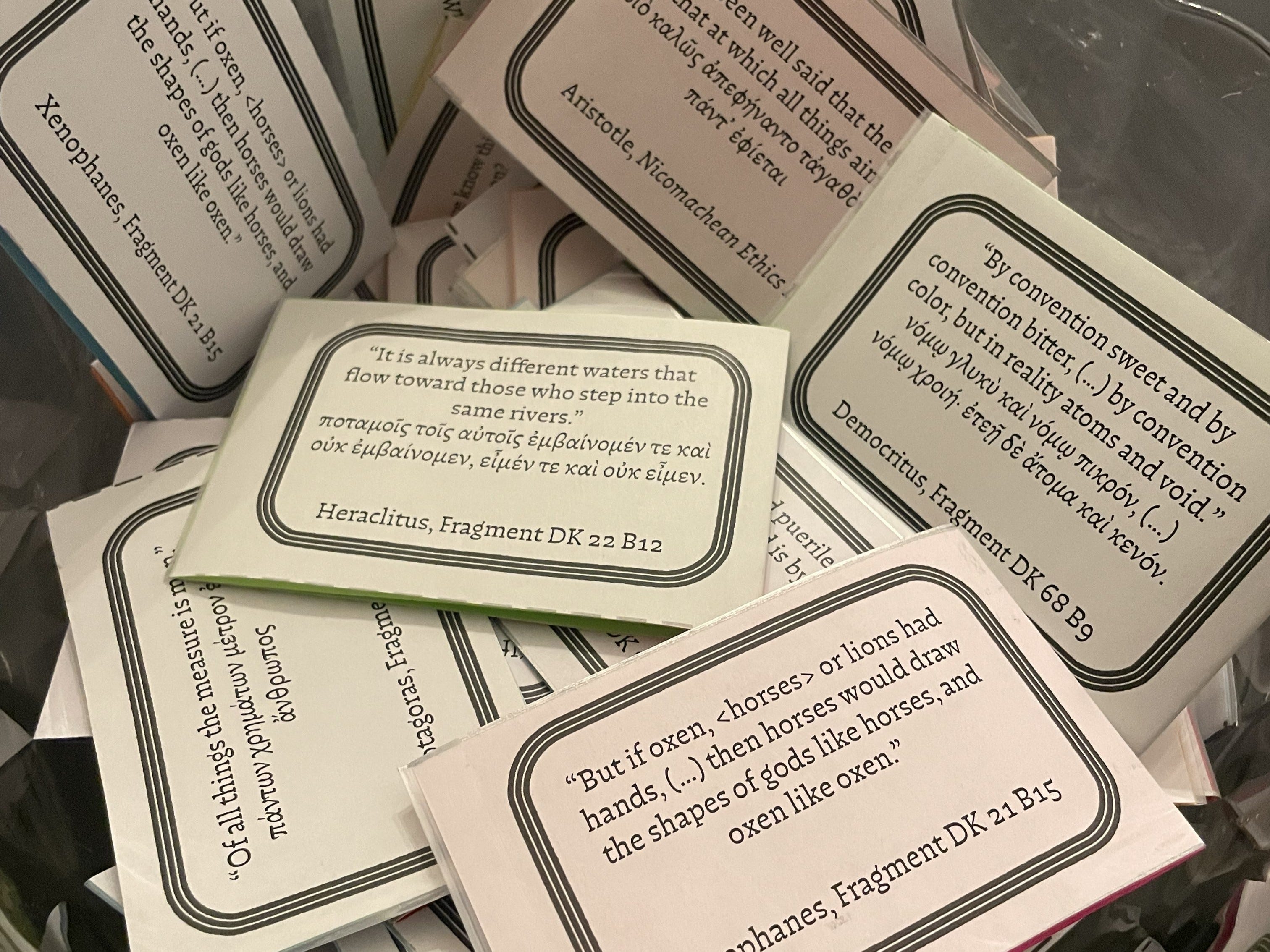
I have always been convinced of the importance of ancient philosophy for contemporary life. The strongest argument in favor of this belief is, to me, fairly straightforward: ancient philosophy gave me tools to ease certain ethical discomforts of my own. For instance, through the philosopher Heraclitus of Ephesus, I learned that running into someone I once called my “best friend” on the street and barely nodding to say hello should not sadden me. Why? Because as Heraclitus tells us in one of his fragments, ποταµοῖσι τοῖσιν αὐτοῖσιν ἐµβαίνουσιν ἕτερα καὶ ἕτερα ὕδατα ἐπιρρεῖ. “It is always different waters that flow toward those who step into the same rivers.” It was no accident that antiquity already called Heraclitus “the Obscure.” What did he mean with his phrase? Well, Heraclitus seems to play with the pair of opposites “different” and “same.” At first glance, the opposing terms apply to two distinct objects—rivers on one hand, waters on the other. But here Heraclitus sets a small trap for us: one can refer to the same element in different ways. The very person who was “my best friend” eleven years ago (a river) is now a “stranger” (only waters). And just as I am not surprised by the different waters my hand comes across when I dip it into the river, I should not be surprised that Paula’s identity ebbs and flows.
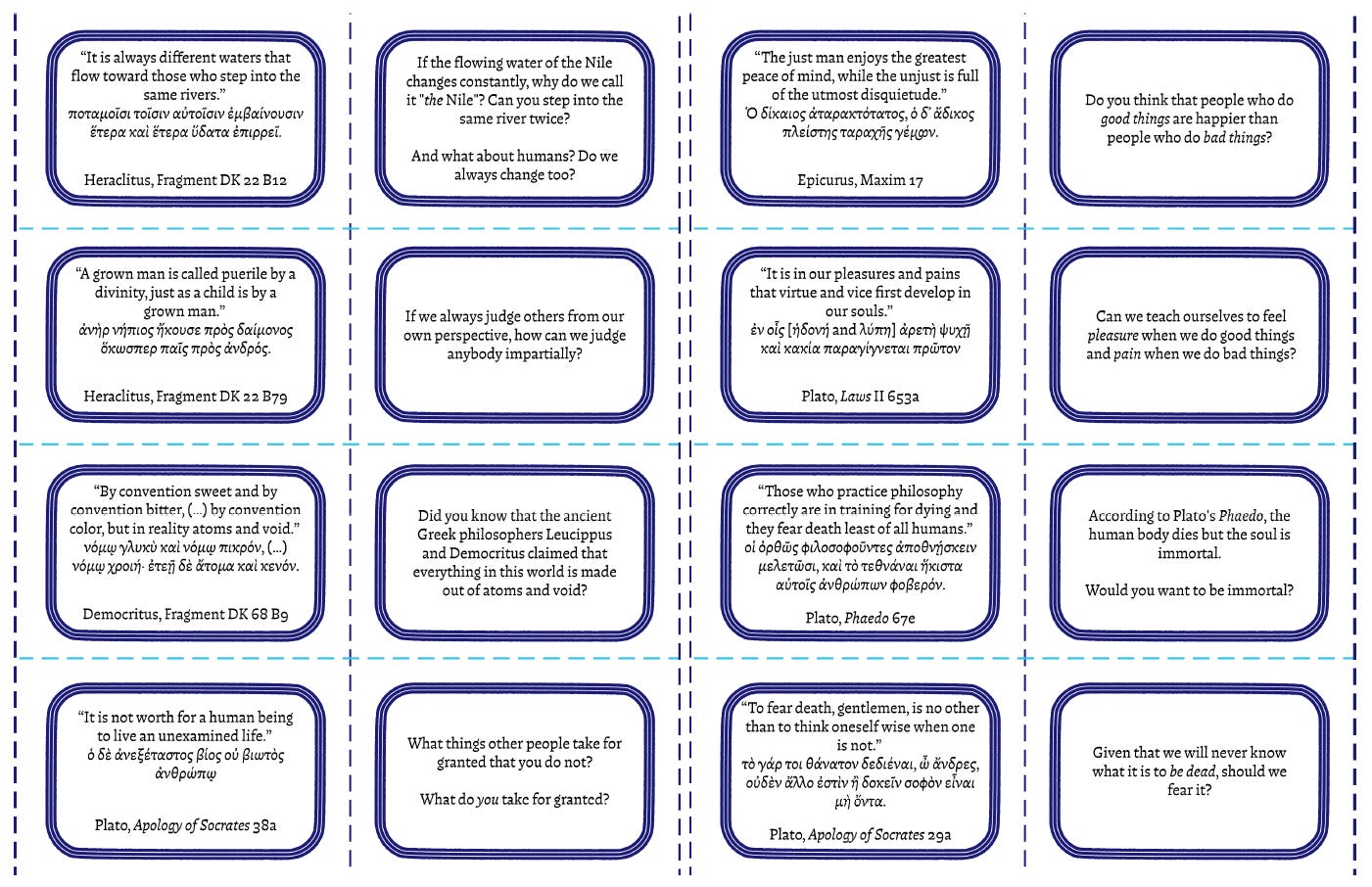
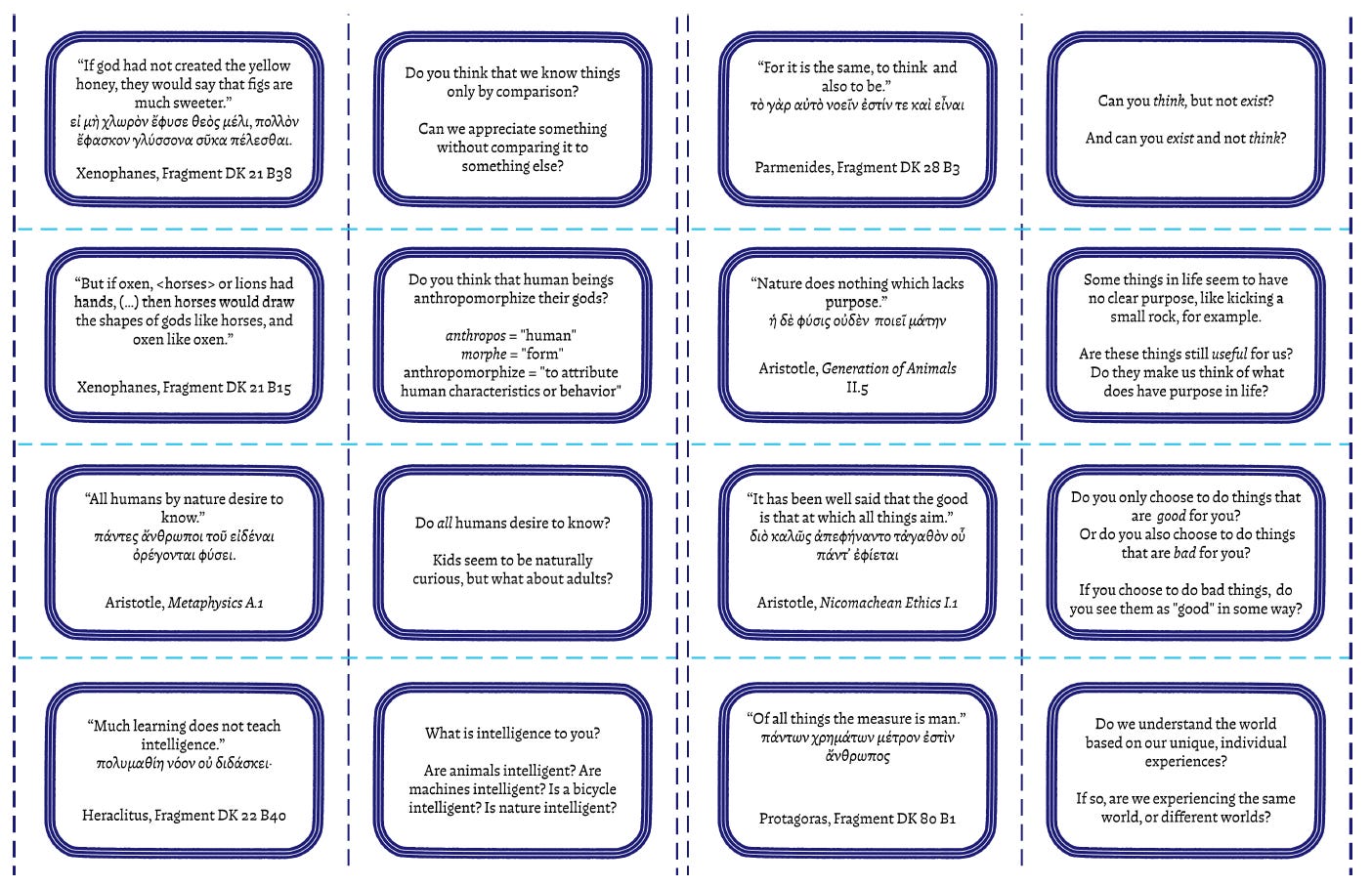
Heraclitus’s fragment was one of the many that I shared with the audience at the 2026 Tucson Festival of Books, and through the various conversations I had throughout the day, I confirmed my initial belief. Ancient philosophy matters, in part because of its power to speak to humans of any time, place, and culture. “I don’t want to live forever,” a child told me. “People take for granted that trees are living,” an artist told me. “AI isn’t truly intelligent—it has no emotions to control,” a father told me. “No human inhabits the exact same world as any other human being,” a group of girls told me, laughing. All of these reflections—and many more—blossomed from a handful of ancient quotations, during brief conversations, under the fierce Arizona sun. Below, I share all the cards I designed for the occasion, in the hope that many more reflections of ancient inspiration will bloom.
El sábado 14 y domingo 15 de marzo de 2026 tuve el placer de participar en el Tucson Festival of Books en tanto profesora del Departamento de Filosofía de la Universidad de Arizona. Mi misión principal era compartir con la comunidad de Tucson algunas de las más lindas ideas que la filosofía antigua tiene para ofrecernos a nosotros, los contemporáneos. ¿Mi misión secundaria? Disfrazarme de Axiotea de Fliunte, una alumna de Platón que debió vestirse de hombre para poder estudiar filosofía en la Atenas antigua.
Siempre estuve convencida de la importancia que tiene la filosofía antigua para la vida contemporánea. El mayor argumento a favor de esta creencia es, para mí, bastante claro: la filosofía antigua me dio herramientas para aliviar ciertos malestares éticos propios. Por ejemplo, de la mano del filósofo Heráclito de Éfeso aprendí que cruzarme por la calle con alguien que alguna vez supe llamar “mi mejor amiga” y apenas mover la cabeza para saludarla no debería entristecerme. ¿Por qué? Porque como bien nos dice Heráclito en un fragmento, ποταµοῖσι τοῖσιν αὐτοῖσιν ἐµβαίνουσιν ἕτερα καὶ ἕτερα ὕδατα ἐπιρρεῖ. “A los que se bañan en los mismos ríos, diferentes aguas son las que les fluyen.” No por casualidad ya en la antigüedad a Heráclito lo llamaban “El Oscuro.” ¿Qué quiso decir con esta frase? Heráclito parece jugar con el par de opuestos “mismos” y “diferentes.” A primera vista, los términos opuestos se aplican a dos objetos distintos—ríos por un lado, aguas por el otro. Pero aquí Heráclito nos tiende una pequeña trampa, ya que uno puede referirse al mismo objeto de diferentes maneras. La misma persona que era “mi mejor amiga” hace once años (un río) es ahora una “extraña” (solamente aguas). Y así como no me sorprenden las diferentes aguas que mi mano se cruza cuando la sumerjo en el río, no debería sorprenderme que fluya la identidad de Paula.
Este fragmento de Heráclito fue uno de los tantos que compartí con el público durante el 2026 Tucson Festival of Books y, a través de las diferentes charlas que tuve a lo largo del día, confirmé mi creencia inicial. La filosofía antigua es importante, en parte por la potencia que tiene para dialogar con los humanos de cualquier tiempo, lugar, y cultura. “Yo no quiero vivir para siempre,” me dijo un niño. “La gente da por sentado que los árboles están viviendo,” me dijo una artista. “La IA no es realmente inteligente: no tiene emociones que controlar,” me dijo un padre. “Ningún humano habita el exacto mismo mundo que otro ser humano,” me dijo un grupo de chicas, riendo. Todas estas reflexiones—y muchas más—florecieron a partir de unas pocas citas antiguas, durante conversaciones cortas, bajo el potente sol de Arizona. Aquí abajo comparto todas las tarjetas que diseñé para la ocasión, con la esperanza de que muchas otras reflexiones de inspiración antigua florezcan.
Mariana Beatriz Noé
Assistant Professor of Philosophy, College of Behavioral and Social Sciences, University of Arizona